MRI Deep Learning Reconstruction
Achieving image quality previously thought impossible due to constraints dictated by MRI physics.
Deep learning has transformed MRI image reconstruction by alleviating the inherent trade-off among field strength, signal-to-noise ratio (SNR), spatial resolution, and scan time. It is now possible to achieve higher SNR and spatial resolution without increasing scan time, and in some cases, with even shorter scan times. This advancement has reshaped our understanding of the MRI physics and has significant implications for clinical practice.
I developed the company’s first end-to-end pipeline for executing and analyzing a randomized, blinded human-observer (radiologist) study to clinically validate an MRI deep learning-based denoising reconstruction (MRI-DLR, commercially known as Advanced intelligent Clear-IQ Engine (AiCE)) in 2019. This pipeline has since been used within Canon Medical Systems for the clinical validation of new technologies. In addition, I contributed to the technical review, bench testing, and broader validation of the technology. My contribution supported Canon in securing FDA 510(k) clearance on March 9, 2020, resulting in the world’s first fully integrated deep learning-based MRI reconstruction technology introduced by a major medical imaging vendor (Canon, Fujifilm, GE, Philips, Siemens, United Imaging).
It is gratifying to see the technology I helped validate now being used clinically across Canon MRI systems worldwide.
Impact of MRI-DLR
Since its inception more than 50 years ago, MRI has been governed by a fundamental trade-off, described as the MRI trade-off triangle, among field strength, signal-to-noise ratio (SNR), spatial resolution, and scan time. This trade-off is dictated by MRI physics: improving one parameter necessarily comes at the expense of one or all of the others.
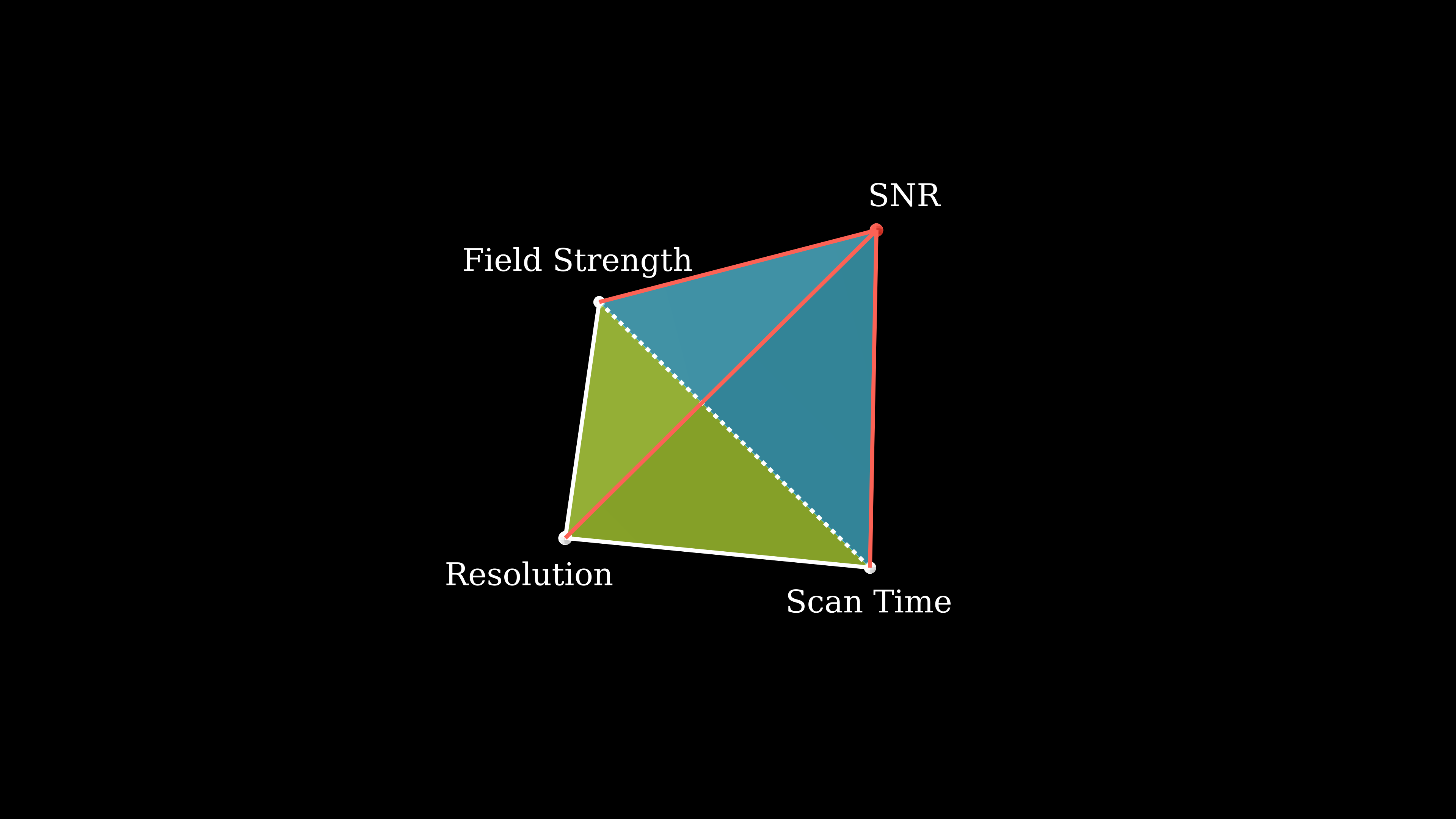
For example, achieving higher resolution typically requires longer scan times or reduced SNR, both of which are undesirable in clinical practice. Alternatively, higher field-strength scanners may be used to boost SNR, but these systems are more expensive and introduce additional challenges related to field inhomogeneity.
Deep learning-based MRI reconstruction (MRI-DLR) has been shown to alleviate this long-standing trade-off triangle by enabling, to some extent, the acquisition of image quality previously unattainable due to constraints imposed by MRI physics. As a results, MRI-DLR allows more flexibility in optimizing MRI protocols to meet clinical needs.
High-field MRI vs. Low-field MRI with DLR
One example is that lower field-strength systems (e.g., 1.5 T) with DLR can, in certain cases, achieve image quality comparable to high-field (e.g., 3 T) MRI without DLR.
Review the whitepaper titled Advanced intelligent Clear-IQ Engine (AiCE) Deep Learning Reconstruction (DLR): Translating the Power of Deep Learning to MR Image Reconstruction for details.
Better IQ without Longer Scan Time
Another example is the ability to achieve higher SNR and spatial resolution without increasing scan time, and in some cases, with even shorter scan times.
Review the whitepaper titled Advanced intelligent Clear-IQ Engine (AiCE) Interpretable Model with Robust and Generalized Performance: Beyond Brain and Knee for details.
Whitepapers
- Do, Hung P. and Berkeley, Dawn. “Advanced intelligent Clear-IQ Engine (AiCE) Deep Learning Reconstruction (DLR): Translating the Power of Deep Learning to MR Image Reconstruction.” Canon Medical Systems USA, 2020. PDF
- Do, Hung P. “Advanced intelligent Clear-IQ Engine (AiCE) Interpretable Model with Robust and Generalized Performance: Beyond Brain and Knee.” Canon Medical Systems USA, 2021. PDF
- Do, Hung P. "Advanced intelligent Clear-IQ Engine (AiCE) Deep Learning Reconstruction: Effectively Removes Noise while Maintaining MR Signal." Canon Medical Systems USA, 2021. PDF
- Do, Hung P. "Good to Know: Advanced intelligent Clear-IQ Engine (AiCE) Deep Learning Reconstruction." Canon Medical Systems USA. PDF-Page53
Peer-reviewed scientific papers
- HP Do, CA Lockard, D Berkeley, B Tymkiw, N Dulude, S Tashman, G Gold, J Gross, E Kelly, and CP Ho. “Improved Resolution and Image Quality of Musculoskeletal Magnetic Resonance Imaging using Deep Learning-based Denoising Reconstruction: A Prospective Clinical Study.” Skeletal Radiology 2024. PDF JRNL-HTML
Get future posts delivered to your inbox.